
Students prepare for months. Panic still begins on exam morning.
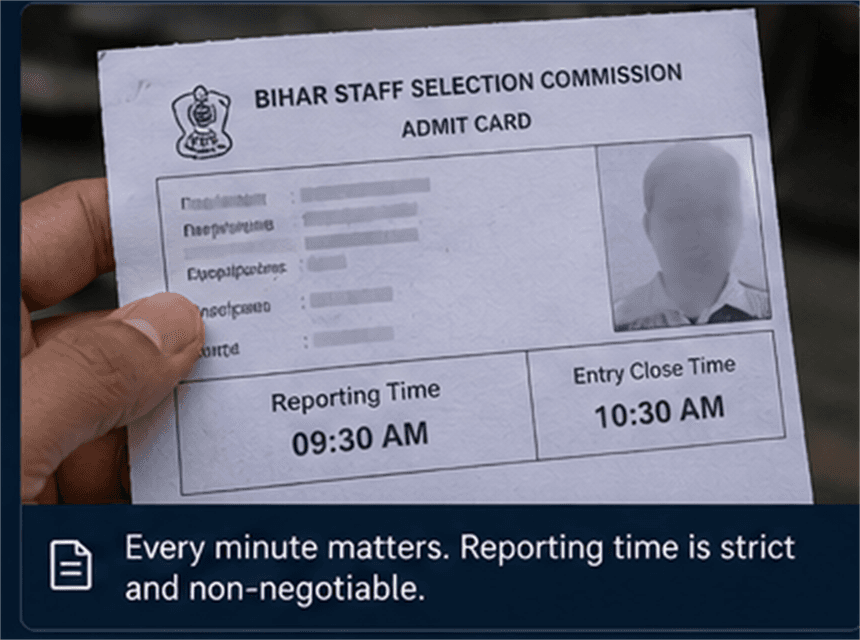
At 4:30 AM, a student leaves home with an admit card, one bag, and one chance.
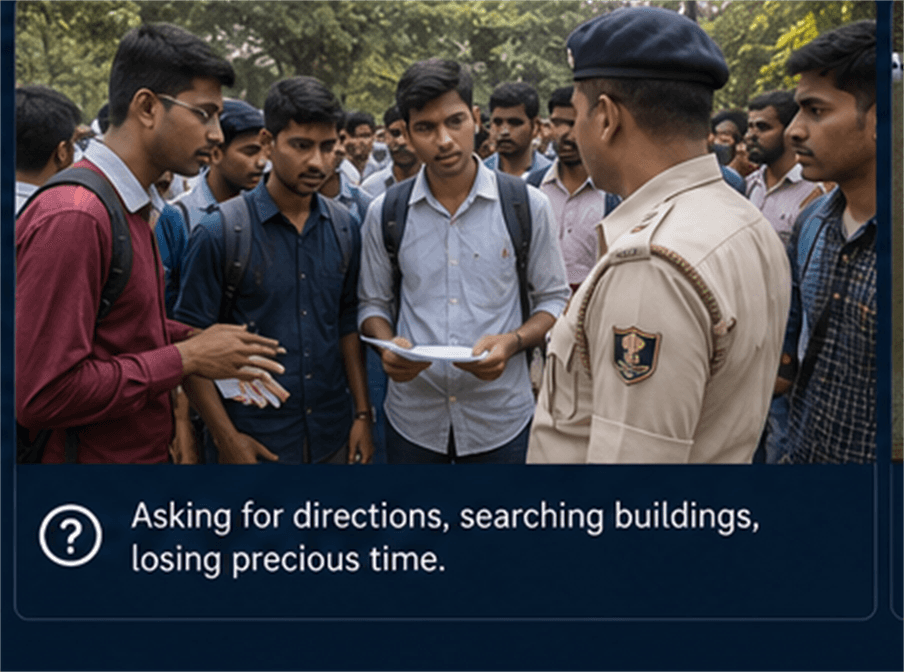
By 7:40 AM, the same student is near the centre but still unsure:
- correct gate or wrong gate
- main road entry or boundary wall side
- map pin right enough or not
- reporting time safe or already risky
Parents are calling. Police barricades are up. Crowd is growing. The student is in an unfamiliar district.
This is not poor preparation. This is movement uncertainty.
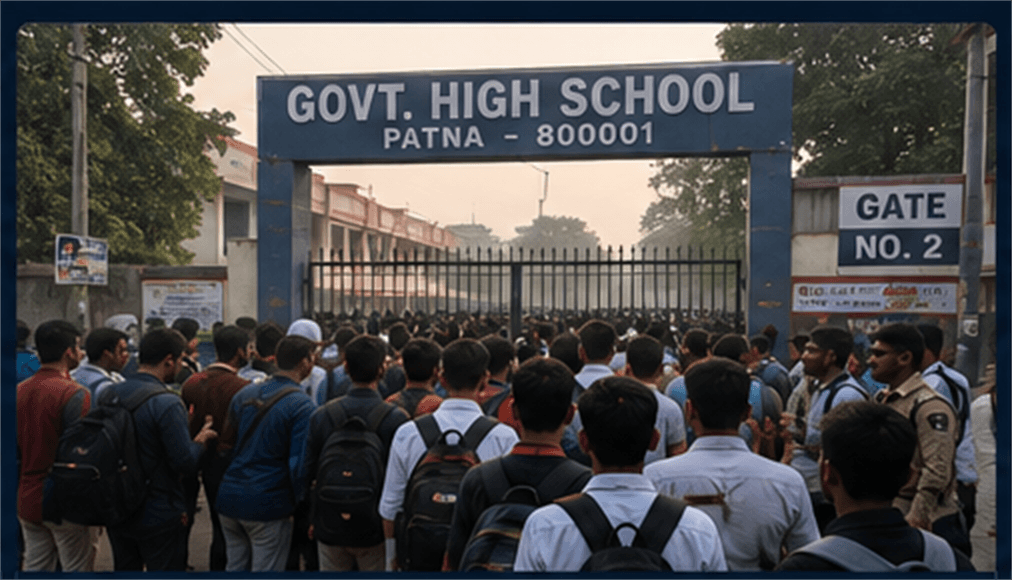
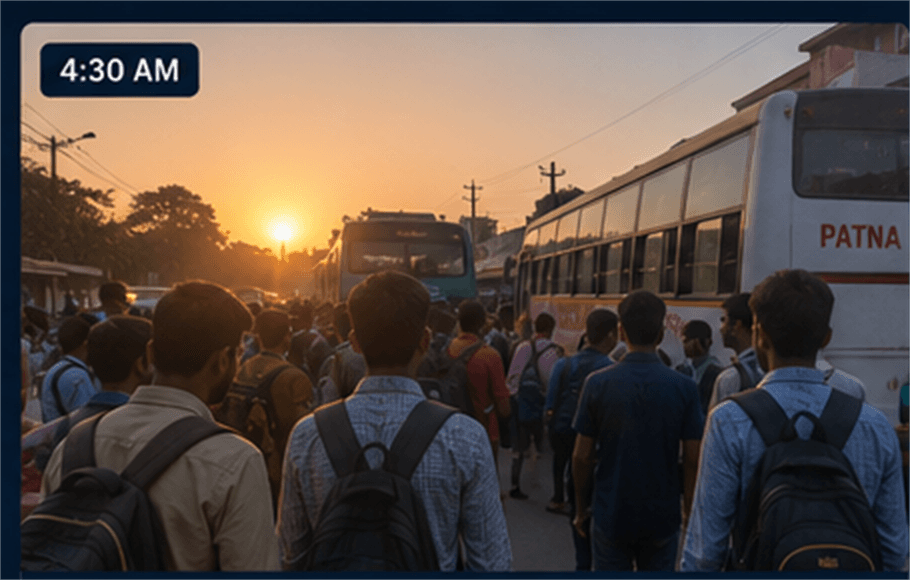
“We reached the centre area on time, but still spent nearly 20 minutes finding the correct gate.”
— BPSC candidate, Patna
Why this matters deeply in Bihar
In Bihar, competitive exams are not just tests. They are family-level opportunities with financial and emotional weight.
Students keep moving across districts for:
- BPSC
- BTSC
- SSC
- Railway
- Banking
- Police
- NEET
- CUET
One serious candidate may appear in multiple exams, multiple centres, and multiple travel conditions in one year.
The scale is bigger than most people realize
Candidate volume across major exam streams
Exam-day stress points (field reality)
Observed pressure index by exam-morning stage (0-100)
Why generic navigation alone does not solve exam-day movement
Maps are useful, but exam-day movement needs exam-specific context:
- many centres have multiple gates
- pins can point to boundary edges
- temporary arrangements change entry flows
- campus layouts are not obvious to first-time visitors
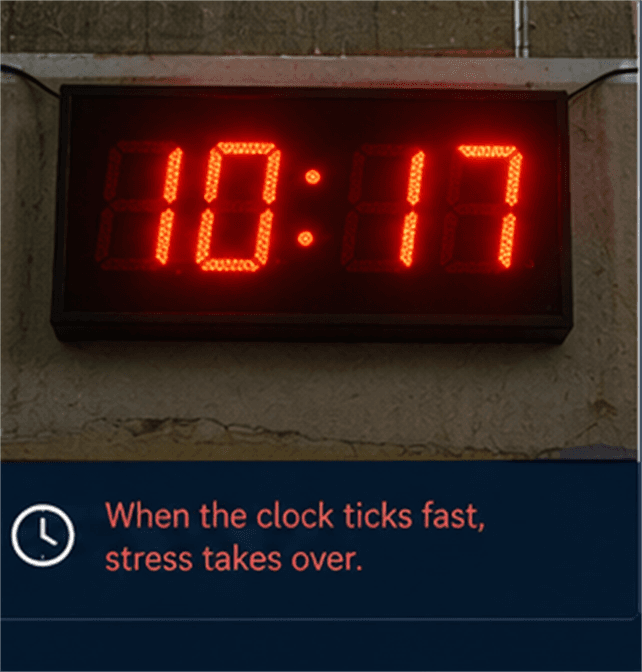
- reporting-time pressure leaves little margin for trial and error
Generic navigation tells you where a place is. Exam-day movement needs confidence that you will reach the correct entry point on time.
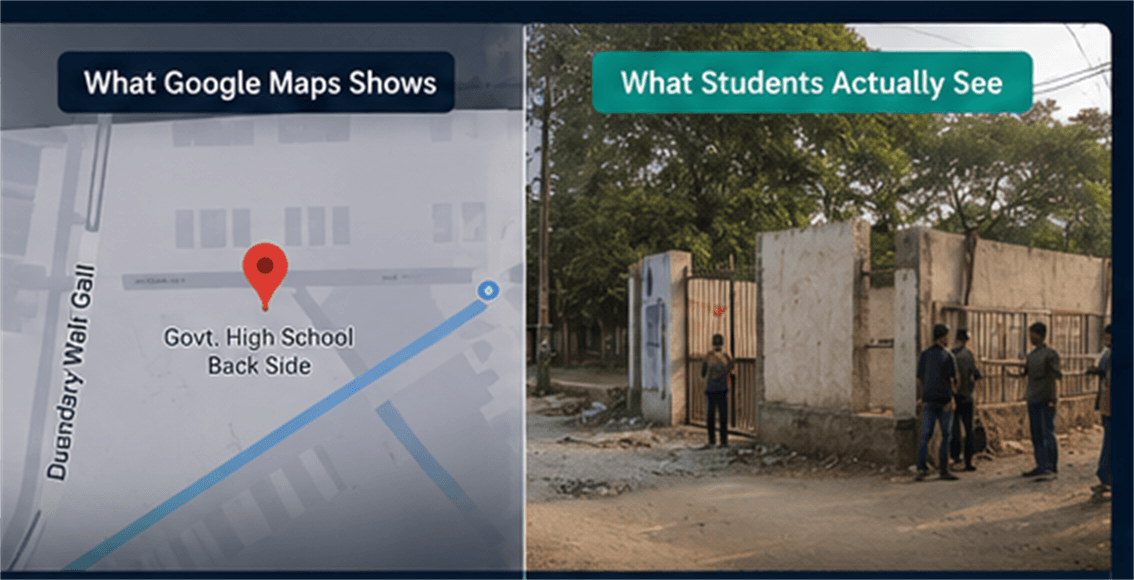
Generic navigation view
- Pin shows boundary wall, not active gate.
- No reporting-time context in route decision.
- Similar centre names create confusion at arrival.
Exam-day clarity view
- Admit-card aware centre identity and gate context.
- Reporting-time buffer guidance built into planning.
- Last-mile certainty with correction-ready local inputs.
Observed exam-day realities
Across repeated exam mornings, the pattern is operationally consistent:
- students reach the correct campus but wrong gate after long travel
- Maps frequently drop candidates near boundary walls, not active entry points
- schools with multiple buildings create final-minute confusion
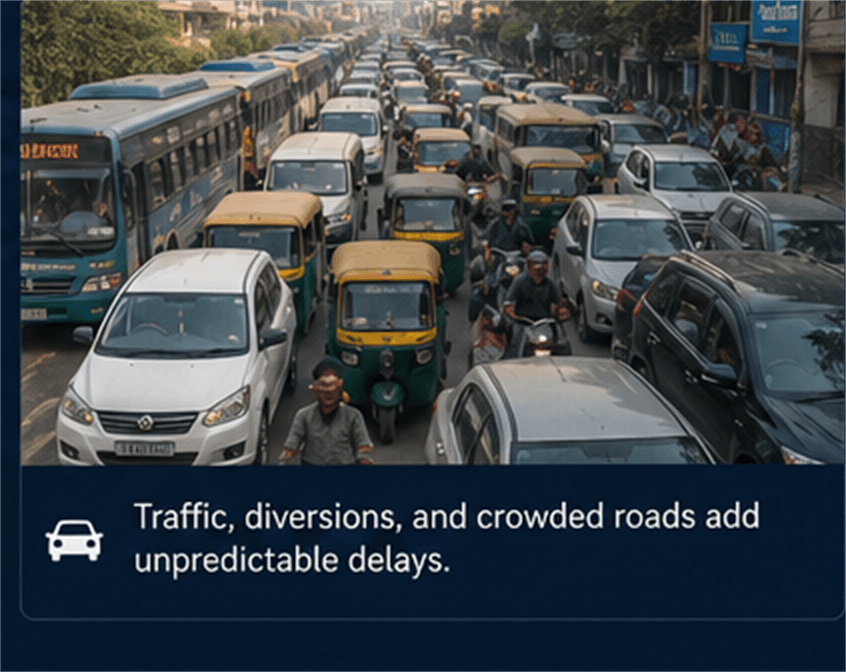
- traffic compression near reporting windows causes avoidable panic
- families wait outside with limited communication clarity
- generic navigation lacks exam-specific context (gate, route fallback, reporting buffer)
These are not edge cases. They are recurring coordination failures in high-pressure movement windows.
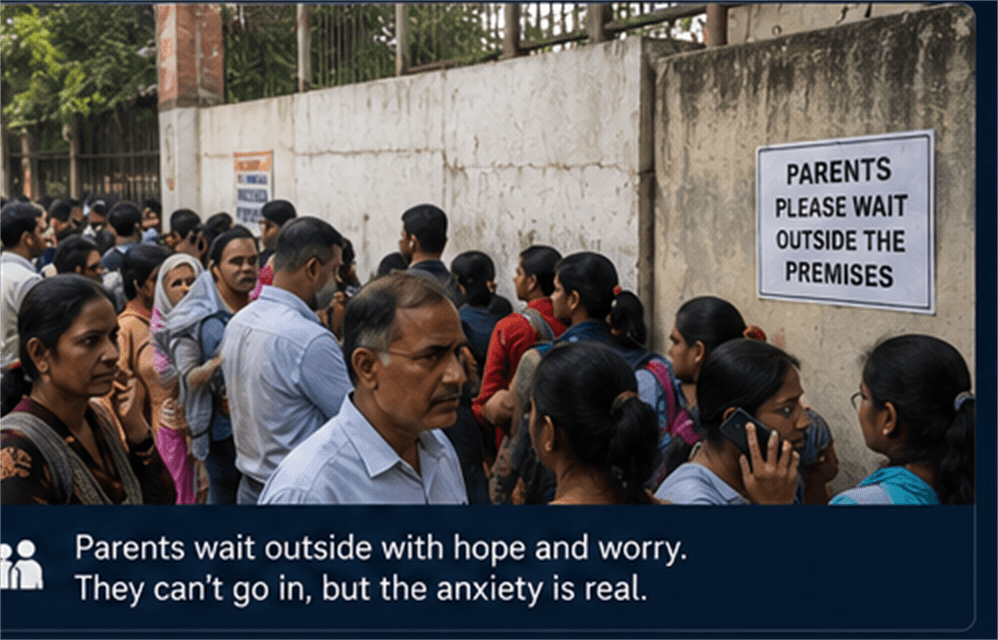
“My parents were more stressed outside the centre than I was during the exam.”
— Railway exam candidate
Why I started with Patna and Bihar
I saw this confusion repeatedly: students preparing seriously while final-mile execution remained weak.
I built Margdarshak as:
1. an exam-day clarity layer 2. a movement guidance system 3. a centre intelligence layer 4. a student coordination platform
Not a coaching platform. Not a motivation app.
Building this requires collective participation
No single system has perfect centre intelligence by default.
Students and local contributors can help improve quality through:
- gate photos
- landmark details
- centre corrections
- missing centre additions
- route observations
Use this to contribute: https://www.margdarshak.co.in/suggest?mode=add
What Margdarshak is not
- not an official exam authority
- not a replacement for admit card instructions
- not a score or rank guarantee
- not another coaching platform
It is an exam-day clarity and coordination system.
Future outlook - what official data already shows
Instead of speculation, I prefer to use current official signals:
- SSC annual-report volume remains very large (2,82,28,973 candidates handled in 2022-23).
- Railway recruitment remains very large (public PIB reporting references over 2.37 crore candidates across two major CBT cycles).
- Air Force recruitment pressure is visible in high application cycles (Agnipath public reporting: 7,49,899 applications in one cycle).
- National entrance movement remains high: NEET (UG) registrations increased from 20,87,462 (2023) to 24,06,079 (2024), with appeared candidates increasing from 20,38,596 to 23,33,297.
- CUET (UG) 2024 still saw very large volume: 13,47,820 unique registered candidates, 11,13,610 unique appeared candidates, and 57,71,668 registered subject tests.
- UPSC Civil Services (Prelims) annual-report cycle shows 10,93,984 applied and 5,08,619 appeared.
- Bihar state streams also remain active through recurring notifications/calendars across BPSC, BTSC, BSSC, police/recruitment cycles, and teacher recruitment exams such as TRE.
For Bihar specifically, planned vacancy and recruitment windows in recent calendars/notifications across BPSC/TRE and related state streams indicate that district-to-city exam movement pressure is not temporary.
Official exam-volume signal (selected systems)
These are different exam systems, but they point to one shared operational reality: exam-day movement volume is already very high.
For students, this means preparation intensity must be matched by movement reliability.
This is where Margdarshak can play a practical role as an exam-day clarity utility layer.
Sustainability and public-value impact
Exam-day clarity is not only a student experience issue. It also has sustainability implications when scaled.
When students reach correct centres with better route confidence:
- avoidable repeat trips reduce
- last-minute detours and idle waiting time reduce
- unnecessary vehicle movement around centres can reduce
- paper/printing overhead from repeated manual re-check loops can reduce
- stress-related crowd turbulence near gates can reduce through better timing discipline
This aligns with practical SDG-linked outcomes:
- SDG 4 (Quality Education): students access exams with fewer logistical barriers.
- SDG 9 (Industry, Innovation and Infrastructure): digital coordination for a public exam-mobility problem.
- SDG 11 (Sustainable Cities and Communities): lower avoidable congestion pressure near high-volume exam centres.
- SDG 13 (Climate Action): reduced avoidable travel and route inefficiency at scale contributes to lower transport waste.
- SDG 16 (Peace, Justice and Strong Institutions): stronger trust in exam-day process integrity through clearer movement and coordination.
Margdarshak is not claiming to solve sustainability alone. But as exam movement scales, small operational efficiencies across lakhs of students can create meaningful cumulative impact.
Build snapshot
Current implementation scale (working repository snapshot):
Core feature coverage includes:
- exam-centre search and selection workflow
- route-planning and timing support
- command-room coordination surfaces
- SOS and guardian communication flow
- centre suggestion and moderation pipeline
- session restore and continuity protections
- operational monitoring and incident handling
- security and verification checks in CI/local workflows
Why I am sharing this publicly
If even a fraction of students can avoid last-minute confusion, wrong gates, unnecessary panic, or route uncertainty, the effort is worth it.
Students already carry enough pressure into an exam hall.
Reaching the right place with clarity should not be another obstacle.
Preparation should decide outcomes. Preventable confusion should not.
Sources
- Ministry of Education, UDISE+ 2023-24 report.
- National Testing Agency, NEET (UG) 2024 result press release.
- National Testing Agency, CUET (UG) 2024 result press release.
- Staff Selection Commission Annual Report 2022-23.
- Press Information Bureau, Ministry of Railways (13 December 2023) recruitment data note.
- Indian Air Force public Agnipath application reporting.
- BPSC exam calendar and public result reporting for recent cycles.
- BTSC/BPSSC/BSSC public recruitment references.